The Birth Place of Disconnection
A Disconnected self is at the core of what causes anxiety, depression, and compulsivity. What is it that causes a disconnection from an authentic/integrated self? The disconnected self happens in a village. The village is that multi-layered eco-system of which we are all a part. The village contains many parts that are influencing a person for better and for worse. The village consists of Family of Origin (Grand Parents, Siblings, Parents and Step Parents, Live in Partners, Aunts, Uncles, Cousins) Extra Curricular Activities, Social Media and pop-culture local hangouts, the neighborhood, religion, educational institutions, Health and human services, medical legal and financial institutions. There are many parts to this village that can make an impact on us. But of all the parts of this village, the family of origin is by far that part that makes the most profound impact upon us-for better and for worse. Why? It has to do with time. It is estimated that the amount of fact to face time we share with our family of origin will be somewhere between 15,000 to 35,000 hours from birth to age 18. That's quantity and not necessarily representative of quality.
Characteristics of the Disconnected Self
The Disconnected Self convinces self and others that they are needless and wantless.
The Disconnected Self tunes into others but fears looking within.
The Disconnected Self is terrified of rejection and will often do anythin required in order to prevent rejection.
The Disconnected Self isolates.
The Disconnected Self worries without ceasing.
The Disconnected Self is spiritually and emotionally bankrupt.
The Disconnected Self wears a number of masks to be in the good graces of others and to cover up the pain not being true to one's self.
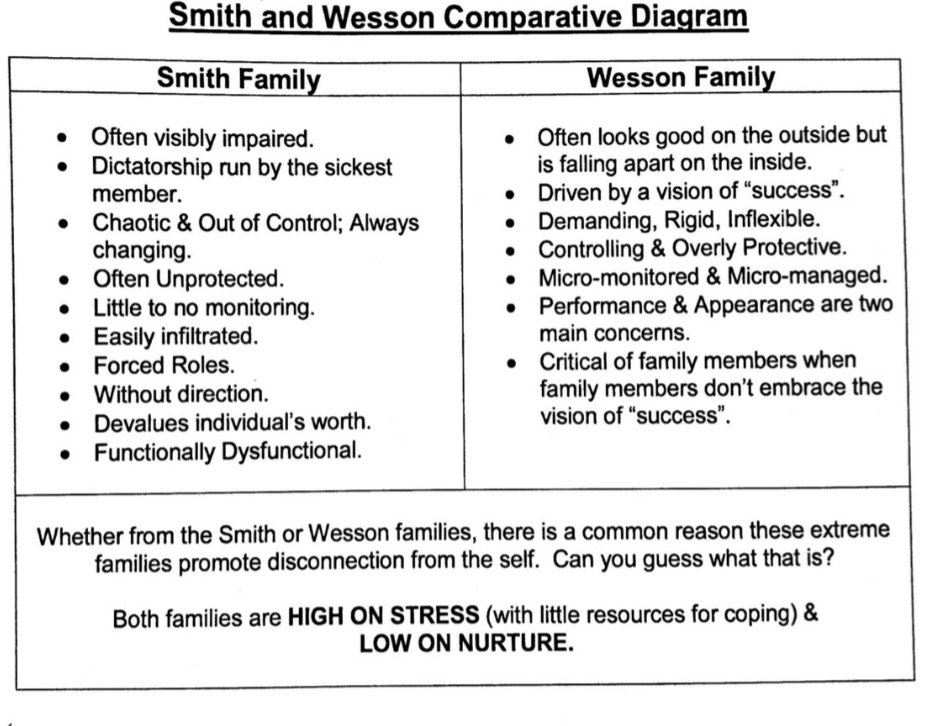
In regard to the kinds of families that incubate disconnection from the self more readily than others, they are polar opposites. And yet, they seem to make family members vulnerable to disconnection. I will refer to these families as the "Smith and Wesson Families."
The Smith family is often equated with the Alcoholic family. It is a family that has been referred to as a dictatorship run by its sickest member. The Smith Family tends to be chaotic and unsettled. Smith families are often in crisis. The crisis could be in relationships, finances, poor decisions made and losses including loss of jobs, reputation and dignity. The children in these families are not monitored and are often given no direction. In some cases the children in these families assume adult roles in order to keep things balanced in the family. Smith families are functionally dysfunctional and often do the same things over and over seeking different results.
The Wesson family is often equated with the Workaholic family. It is a family that tends to be driven by a vision of success. Success has various way in which it could be defined. However, the vision of success in Wesson type families tends to aim toward one of the following:
Professional vision of success-Professionals live the country club life. They keep up appearances and make sure that they are seen by other professionals who are living the country club life.
Perfectionist vision of success-Perfections live out the Protestant Work Ethic to the max. This vision of success requires hard work with little rest or leisure. There is no room for recreational endeavors except obligatory exercise routines that help one maintain their energy levels.
Plus vision of success-Pious Wesson's are working very hard to live from a prescribed set of religious rules and regulations. The pious Wesson's see success as doing what their brand of organized religion prescribes. This prescription is highly important to the Pious Wesson and the end game is salvation or treasures in heaven.
Wesson families are highly structured and micro-monitored. Wesson families tend to the rigid and demanding, critical and controlling, image conscious and performance driven. Wesson families care very little about personal preferences. Instead, they make demands on the family members to conform to whatever the vision of success is no matter what it may cost.
Which family did you come from?
Most People can identify wither one or the other or some combination (hybrid) of the two. Either situation (Smith/Wesson) is like living in a pressure cooker. You are constantly faced with internal/external pressures with very few resources on board to know how to cope. Thus, in an effort to somehow survive such situations, there is a tendency to disconnect. Another way to talk about the disconnection is by referring to it as Self Abandonment. Self Abandonment is what happens when the true self goes into hiding and the adapted self (or False Self or Mask-Wearing Self) emerges.
Stressed Out Sound Bytes of Smith & Wesson Kids:
Who will love me? Who will be there for me when I'm scared? Who will make sure I am fed? How can I keep from being taken away from my family? How do I make sure nobody knows what is happening at home? It is not ok to have needs. I must learn to take care of myself all by myself. No one is going to make this any better. How do I protect my siblings? How do I get attention? No one is listening to me. No one seems to care about me. I must be bad. There must be something wrong with me. I have to be the strong one. I have to keep things calm. I have to take the hits from the dictator.
Wesson Family Stress Leads to a number of perplexing question's and thought:
I must produce and perform in order to be loved. I have to succeed. There is no room for me to what I want to be when I grow up. How an I ever tell them who I really am? How do I keep the peace? What will get them off my back? I am not allowed to make mistakes. I have to make them look good. I will never be good enough. I have to be the best. I must be perfect. I can't stand all the pressure. This is too much. Never let them know how you feel. Never show signs of weakness. Keep it all together all the time. It is better to look good than it is to feel good. God will never love a wretched soul like me.
Low on Nurture
Along with mismanaged stress, Smith & Wesson families are also low on nurturing. Nurturing is what helps a person to form a sense of security and contentment. Healthy nurturing helps people to grow up as connected selves.
The Four A's of healthy Nurturing
There are 4 A;s that seem to capture the essence of healthy nurturing. Each of the A;s has a saying that captures the essence of what someone receives when they get the nurture they need.
Affirmation-Affirmation has to do with emotional support and encouragement. When a child is affirmed, they learn that they are valued. The saying that expresses the essence of affirmation is "I celebrate you."
Attention-Attention is what is given when the parent attunes to the child and listens to his/her ideas, hopes, dreams, struggles and fears. Attention is also aware of a child's coming and going; a child's whereabouts; a child's behaviors. The saying that expresses the essence of attention is "I hear you and I see you."
Affection-Affection is the physical side of nurture. Examples include holding hands, love pats. hugs, wrestling, back rubs, stroking of hair, tickling, piggy back rides, being thrown in the pool, butterfly kisses, handshakes, high fives and kisses on the forehead and cheeks. The saying that expresses the essence of affection is "I am bonded to you physically and emotionally."
Approval-This is what happens when parents receive their children with unconditional positive regard. The saying that expresses the essence of approval is "I accept you as you are-no strings attached."
When a child grows up with that kind of nurture, it helps the child remain secure and true to him or herself.
Location
715 North Washington Blvd,
Suite E,
Sarasota, FL 34237
Contact Us
Hours of Operation
Monday
8:00 am - 8:00 pm By Appointment Only
Tuesday
8:00 am - 8:00 pm By Appointment Only
Wednesday
8:00 am - 8:00 pm By Appointment Only
Thursday
8:00 am - 8:00 pm By Appointment Only
Friday
8:00 am - 8:00 pm By Appointment Only
Saturday
Closed
Sunday
Closed